Consistency · 7 min read
Why You Keep Starting Over—and How to Break the Restart Loop
One missed day does not erase your progress. Learn how to stop abandoning habits and continue from where you are.
If you keep starting a habit with energy and abandoning it after one missed day, the problem may not be motivation. It may be the way you think about restarting.
I have started learning to code more times than I can count. Each restart looked promising. I would choose a course, clear my schedule, and tell myself that this time I was serious. For a few days, sometimes a few weeks, I was.
Then life got busy. I missed a session. One missed day became three. Soon, opening the course felt like proof that I had failed again—so I searched for a better course and started from lesson one.
I did the same thing with exercise and reading: new plan, strong start, small interruption, quiet disappearance, fresh restart. Eventually I realized that beginning again was not the same as moving forward.
The Restart Loop
The problem was not that I could not begin. I had become very good at beginning. The problem was the story I told myself after I stopped.
I treated consistency like a perfect streak. Once the streak broke, the whole effort felt spoiled. Restarting gave me a clean feeling, but it also erased the evidence that I had already made progress.
The Restart Loop: begin with intensity → miss once → feel behind → abandon the plan → search for a cleaner beginning.
Progress is not a clean line
Habit formation is often translated into a simple promise: repeat something for enough days and it becomes automatic. Real life is messier. Repetition in a familiar context gradually makes a behavior easier to begin, but imperfect days are still part of the process.
One missed workout does not erase the strength you built. One missed reading session does not remove what you learned. What hurts is turning one interruption into a long absence.
Continue from where you are
When I returned to coding, I stopped going back to lesson one. I opened the last project, found the smallest piece I still understood, and worked from there for twenty minutes.
The same rule worked for exercise: do not create a new twelve-week plan; take a walk today. For reading: do not choose a new book; read two pages of the one already open.
You do not need a clean slate. You need a next step. If that next step still feels too large, use a minimum habit—an intentionally small version that keeps your connection to the behavior alive.
One action
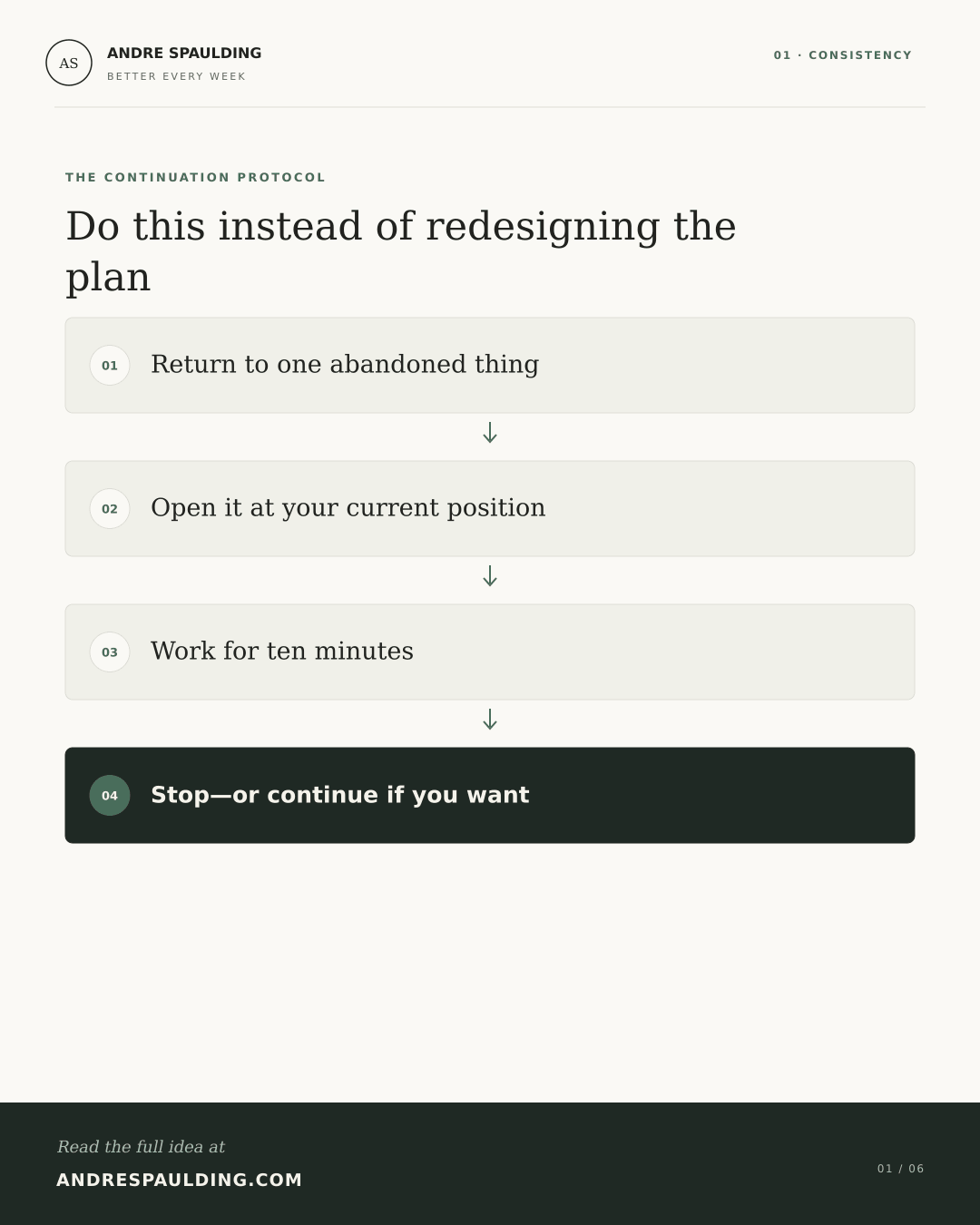
Return to one thing you have quietly abandoned. Do ten minutes from your current position. Do not redesign the plan.
One question
What could you continue today if you stopped demanding a perfect restart?